Quoted post
KawzInvests · (@KawzInvests) · 2026-09-28
View quoted post
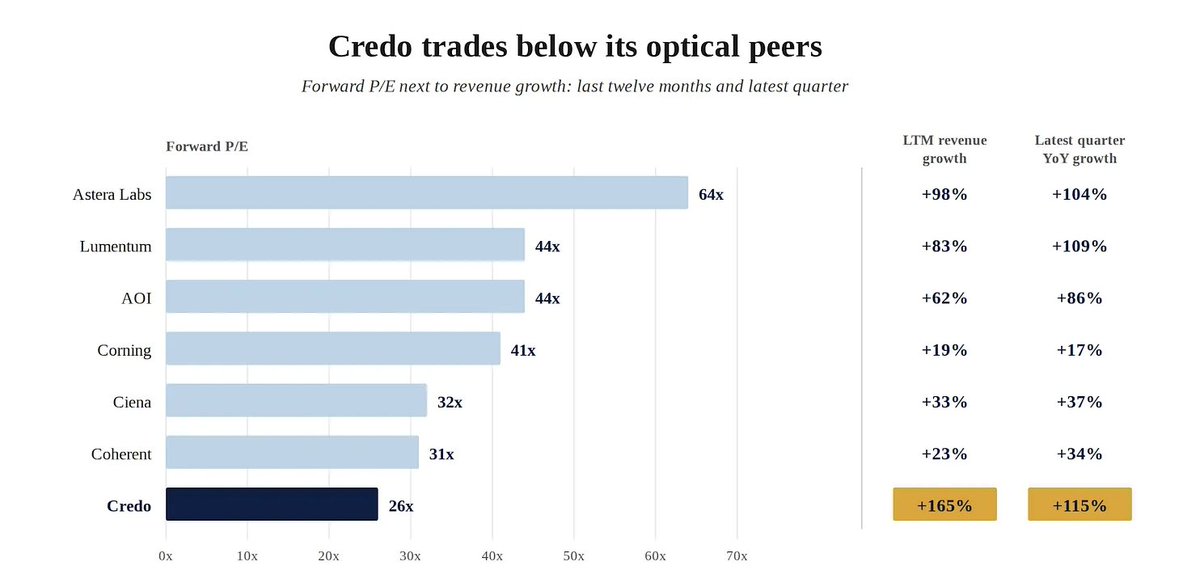
Why the $CRDO long-term growth story is much bigger than AECs.
Credo generated roughly $1.34B in FY26 and guided to more than 85% growth in FY27, with analysts targeting around $3.9B in FY28. Where does that growth come from as AEC growth naturally moderates?
First, AECs still have room to grow. Credo has deep relationships with five hyperscalers and is preparing for the 1.6T bandwidth transition.
At 1.6T, AEC reach extends to roughly 6.5 meters, keeping copper highly competitive on power and cost over short distances. 1.6T AECs start contributing in the second half of FY27 and ramp significantly in FY28.
Second, optics is growing faster than AECs and is expected to contribute more than $600M in FY27.
Credo has three optical businesses, each expected to exceed $100M in FY27:
Optical DSPs, with record engagement across 800G and 1.6T
Silicon photonics, through the DustPhotonics acquisition
ZeroFlap optical transceivers
Third, a key part of ZeroFlap’s moat is the Pilot software layer.
Silent optical network failures can drain 10%–20% of GPU cluster utilization. Pilot gives hyperscalers an early warning before links fail and helps cut cluster bring-up times from weeks to days. Better utilization can reduce the need for additional GPU spending, potentially saving hundreds of millions of dollars.
Looking into FY28 and beyond, Credo is entering Near Package Optics, or NPO, for scale-up AI networks, where connection density is 10 times higher.
Credo is expanding from an AEC supplier into a broader electrical and optical platform, giving it more ways to grow as AI networks become faster, denser and more demanding.
$NVDA $LITE $CRDO $SMTC $COHR $AAOI
Why it's worth your time
A named deep dive on $CRDO published on Asymmetric Bets, with the segment math in the quoted thread: optics above $600M in FY27 across optical DSPs, silicon photonics and ZeroFlap transceivers, with 1.6T active electrical cables ramping in FY28. It is the bull case for a core optical-supercycle name, stated as checkable segment targets rather than a price call.